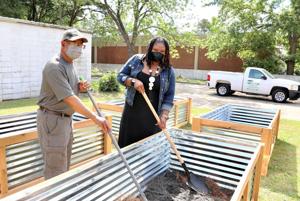
Samaritan House director Henry Miller talks about the benefits of being able to grow fruits and vegetables at the Orangeburg shelter.
Orangeburg, Bamberg and Calhoun county residents are more physically active, but are still struggling with adult obesity.
Orangeburg County ranks as the state’s 34th healthiest county in the 2023 County Health rankings report. South Carolina has 46 counties.
Orangeburg County moved up slightly in the rankings. It was ranked as the 35th healthiest county in last year’s national report.
The University of Wisconsin Public Health Institute releases the annual report with funding from the Robert Wood Johnson Foundation.
Bamberg County is ranked the 33rd healthiest county, up from 34th last year.
Calhoun County continued to be ranked the 25th healthiest county in the state.
The region saw some of its worst rankings in the areas of adult obesity and child poverty.
People are also reading…
The report says 44 percent of adults in Orangeburg County and 43 percent of adults in Bamberg County are obese, up from 41 percent in both counties in last year’s report. In Calhoun County, 40 percent of adults are obese, up from 37 percent last year.
The state average is 37 percent.
An estimated 42 percent of children were living in poverty in Orangeburg County, much higher than the state average of 20 percent.
It’s an increase over last year’s report, which said 30 percent of children lived in poverty in the county.
Bamberg County reported the same percentage of children living in poverty as last year at 34 percent.
In Calhoun County, 26 percent of children under 18 were reported living in poverty. That’s an increase from the 22 percent reported living in poverty in the county in last year’s report.
Some 31 percent of adults 18 years of age and older reported no leisure physical activity in Orangeburg County. The county improved slightly from 33 percent in last year’s report.
In Bamberg County, 31 percent reported physical inactivity, an improvement from 35 percent last year.
In Calhoun County, 28 percent reported no leisure physical activity, an improvement from 31 percent last year.
The state average is 26 percent.
Fifty percent of the Orangeburg County population were reported to have adequate access to locations for physical activity. Sixty-three percent of Bamberg County’s population reported access to exercise opportunities, while 17 percent of Calhoun County’s population reported having adequate access to locations for physical activity.
That state average is 70 percent.
The University of Wisconsin Public Health Institute report ranks the overall health of nearly every county in the nation. Each of South Carolina’s 46 counties was ranked on key factors that affect health, such as obesity, binge drinking, access to primary care providers and the number of children in poverty.
The Tri-County Health Network, a nonprofit formed to improve the health of residents in the tri-county region, is housed at MUSC Health-Orangeburg. Its 2022 Community Health Needs Assessment can be found online at muschealth.org/orangeburg.
TCHN Manager Dr. LaShandra N. Morgan has cited the need to have meaningful data in assessing the community health needs.
According to the County Health Rankings report, the tri-county area improved in the percentage of individuals reporting to be in poor or fair health.
The report says 20 percent of individuals in Orangeburg County reported being in poor or fair health. It was 24 percent last year.
In Bamberg County, 19 percent of individuals reported being in poor or fair health. It was 25 percent in last year.
Also, in Calhoun County 17 percent of residents reported being in fair or poor health. It was 21 percent in last year’s report.
The state average is 18 percent.
Morgan says the Tri-County Health Network’s coalition has been working with others to improve lives.
“We have a lot of partners. We have things that we do, but we make sure that we work together and not in silos so that people aren’t duplicating effort. We put our minds together to come up with what’s best for the community,” Morgan said.
“So we have been doing fresh produce distributions. We’ve been pushing the Diabetes Prevention Program. We’ve been having community conversations so that communities know that we’re listening to their community voice,” she said.
Morgan continued, “So we tend to work on things they want to work on and not things that we want to work on. I always tell folks that I don’t sit in a public health bubble and decide what the community should do. I let them tell me.”
The TCHN partners with the Bamberg County Community Rural Arts Work League, or CRAWL, to offer exercise classes in the county.
“They applied for some funding to do exercise classes. Right now in Bamberg County, there’s a lot of dance classes and line dance classes going on. So there’s a lot of momentum around exercise. In Calhoun County, we worked with the county to do a lot of fresh produce distribution,” Morgan said.
The network received a $50,000 grant from the Diabetes Action Council of South Carolina last year, funding which has allowed it to offer a diabetes prevention course in Orangeburg, Bamberg and Calhoun counties.
“Right now we have seven cohorts running. They’ve been doing really well. … A person here in the Orangeburg cohort was talking about needing surgery done on their knee, but they’ve lost so much weight that they don’t need surgery anymore. It’s not bothering them as much.
“We had another person participating in the cohort that said that they’ve been implementing the things that they talk about in the class at home. Their child, who was diagnosed with Type 2 diabetes, no longer has to take insulin. So we’ve been having some success stories,” Morgan said.
She said work has been done to create more walkable communities.
The TCHN and MUSC Health-Orangeburg encourage individuals to participate in Walk with a Doc, a health program that brings doctors and patients together to walk the first Saturday of the month at 10 a.m. at the MUSC Health-Orangeburg track.
The TCHN has also started a Walk with Ease program through the Arthritis Foundation
“We’re working with DHEC right now to offer the Walk with Ease program in St. Matthews at the John Ford Community Center and the Orangeburg County Library. We’re also looking to offer cooking classes. With the Cooking Matters class, it’s like they do cooking demonstrations, but they also like give you the ingredients to take home so that you can cook the stuff yourself,” Morgan said.
“Then there is another class called ‘It’s Your Health, Take Charge,’ where they teach you how to manage your hypertension, your blood sugar and things like that through diet. So we’re going to see about offering that at the Orangeburg County Library, and we will be offering it at the John Ford Community Center in St. Matthews,” she said.
The TCHN is also home to the Food Policy Councils, which have a presence in Bamberg, Calhoun and Orangeburg counties.
“They as a community decide what it is they want to work on in their respective communities as far as food. Some people want to do some data collection. Some people want to see what the community needs. Some want to offer healthy cooking classes and teach young parents how to cook healthy meals for their children, along with grandparents because there are a lot of grandparents raising their grandchildren. Then some Food Policy Councils are new and still trying to decide,” Morgan said.
A $300,000 grant from the S.C. Center for Rural and Primary Health Care has allowed the TCHN to place a social worker in the Orangeburg County Library.
“She’s doing an amazing job. She, along with the deputy director at the library are working together to launch Orangeburg County Move. So they’re going to be offering some movement activities and working with different folk in offering programs at the Orangeburg County Library,” Morgan said.
Healthy food box distributions are also being held, while the development of school and community gardens has been another successful initiative within the tri-county area.
“With the community gardens, we work with a group called Growing COB, which stands for Calhoun, Orangeburg and Bamberg. We actually have two new gardens launching hopefully by the end of the month in St. Matthews at the John Ford Community Center and in Cope at Macedonia AME,” she said.
Morgan continued, “I’m really excited about the garden in St. Matthews because it’ll be our first one in Calhoun County at the John Ford Community Center. They’ve been very supportive in trying to implement programs for the community. They’ve been doing a really good job.”
She has said the whole goal of the TCHN is to help reduce the risk of chronic disease, with an enhanced focus on holistic health beyond exercise and healthy eating.
“We’re also focusing on healing. So we’re starting to talk more about wellness in general, which includes mental health. So we try to tackle chronic disease. With obesity, it’s a multifaceted issue, though. It doesn’t just have to deal with eating and exercise like people think.
“It has to do with stress and how that actually impacts the body. … It’s not just about what you eat and whether you’re exercising or not. There’s a lot behind that. So we also try to deal with the social determinants of health, policy systems and environmental challenges. Some things are a marathon and not a sprint,” she said.
For more information on the TCHN and its initiatives, contact Morgan by email at morglash@musc.edu or visit the TCHN Facebook page at www.facebook.com/TriCountyHN.
Contact the writer: dgleaton@timesanddemocrat.com or 803-533-5534. Follow “Good News with Gleaton” on Twitter at @DionneTandD
#lee-rev-content { margin:0 -5px; } #lee-rev-content h3 { font-family: inherit!important; font-weight: 700!important; border-left: 8px solid var(–lee-blox-link-color); text-indent: 7px; font-size: 24px!important; line-height: 24px; } #lee-rev-content .rc-provider { font-family: inherit!important; } #lee-rev-content h4 { line-height: 24px!important; font-family: “serif-ds”,Times,”Times New Roman”,serif!important; margin-top: 10px!important; } @media (max-width: 991px) { #lee-rev-content h3 { font-size: 18px!important; line-height: 18px; } } #pu-email-form-daily-email-article { clear: both; background-color: #fff; color: #222; background-position: bottom; background-repeat: no-repeat; padding: 15px 0 20px; margin-bottom: 40px; border-top: 4px solid rgba(0,0,0,.8); border-bottom: 1px solid rgba(0,0,0,.2); display: none; } #pu-email-form-daily-email-article, #pu-email-form-daily-email-article p { font-family: -apple-system, BlinkMacSystemFont, “Segoe UI”, Helvetica, Arial, sans-serif, “Apple Color Emoji”, “Segoe UI Emoji”, “Segoe UI Symbol”; } #pu-email-form-daily-email-article h2 { font-size: 24px; margin: 15px 0 5px 0; font-family: “serif-ds”, Times, “Times New Roman”, serif; } #pu-email-form-daily-email-article .lead { margin-bottom: 5px; } #pu-email-form-daily-email-article .email-desc { font-size: 16px; line-height: 20px; margin-bottom: 5px; opacity: 0.7; } #pu-email-form-daily-email-article form { padding: 10px 30px 5px 30px; } #pu-email-form-daily-email-article .disclaimer { opacity: 0.5; margin-bottom: 0; line-height: 100%; } #pu-email-form-daily-email-article .disclaimer a { color: #222; text-decoration: underline; } #pu-email-form-daily-email-article .email-hammer { border-bottom: 3px solid #222; opacity: .5; display: inline-block; padding: 0 10px 5px 10px; margin-bottom: -5px; font-size: 16px; } @media (max-width: 991px) { #pu-email-form-daily-email-article form { padding: 10px 0 5px 0; } } .grecaptcha-badge { visibility: hidden; }